Enter your savings, spending and income. Afterwork Plan runs your plan through every stretch of US market history since 1928 and shows you the earliest month you can stop, and the paycheck you'll have from then on.
About 10 minutes. No account and no bank logins. Your numbers stay on your device.
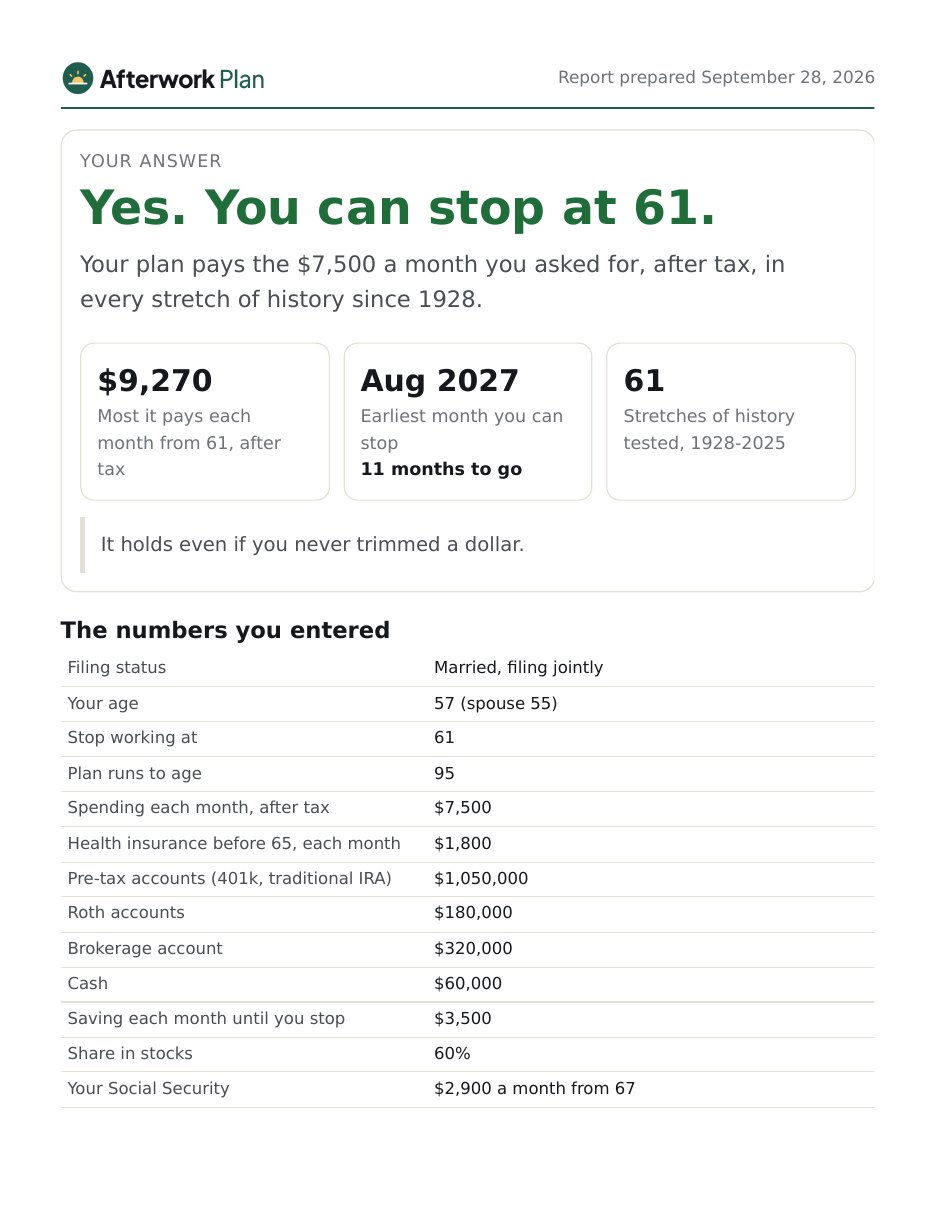
A made-up couple, 57 and 55, with $1.61 million saved and $7,500 a month to spend.
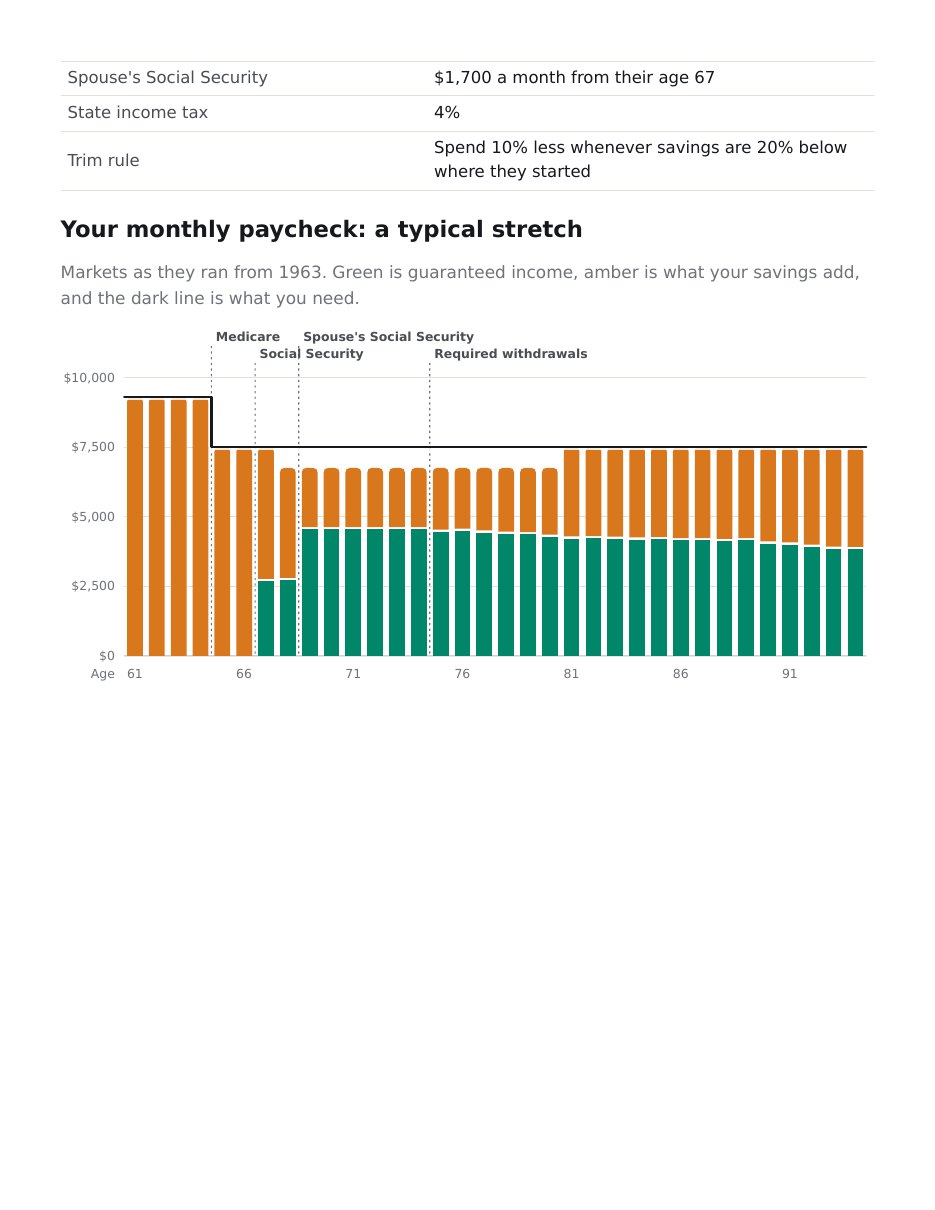
Here's the example couple's monthly take-home from the day they stop, after tax and adjusted for inflation, so a dollar on the chart buys what a dollar buys now. Green is income that arrives whatever markets do, like Social Security. Amber is what their savings add. The dark line is what they need each month.
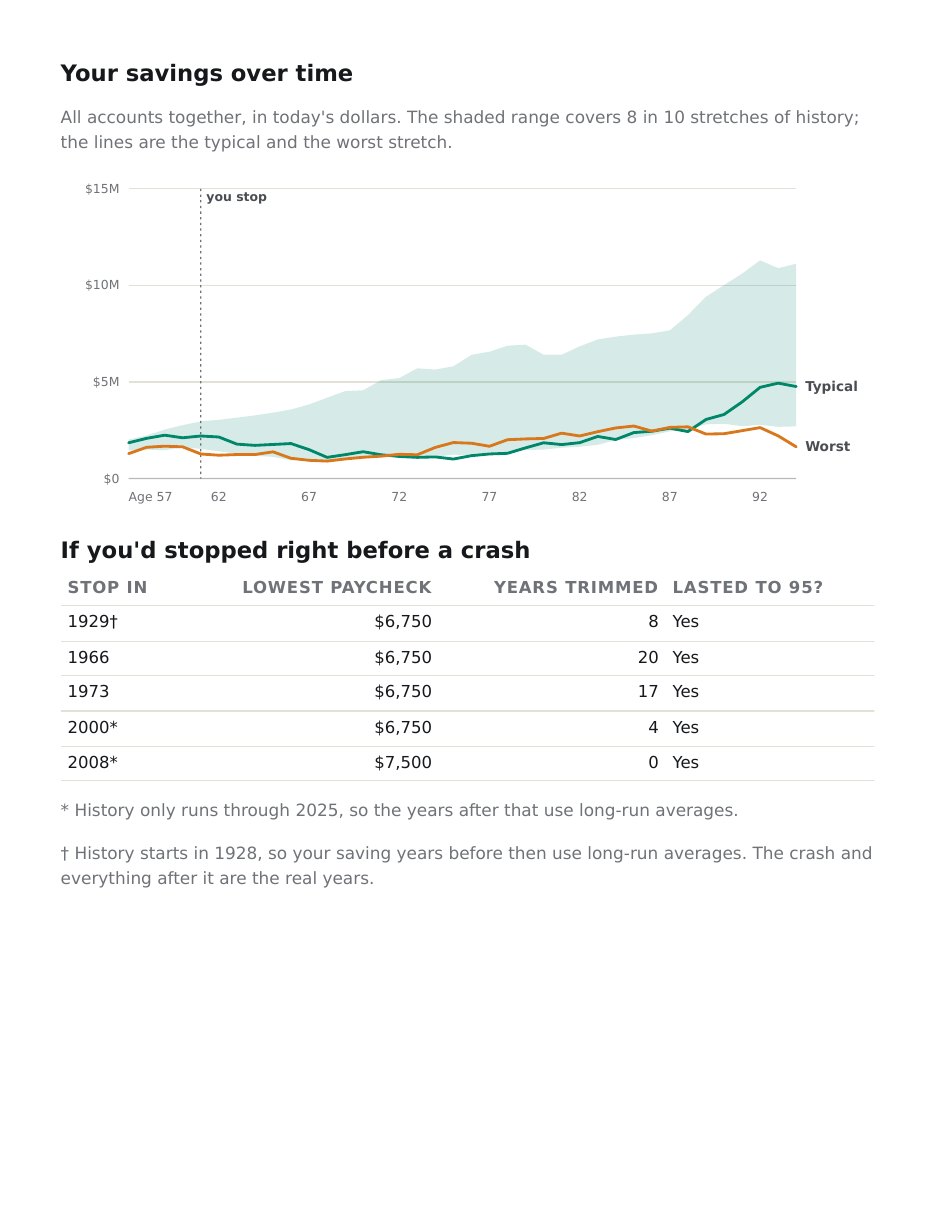
All the accounts together, year by year. The shaded range covers 8 in 10 stretches of history since 1928. The green line is a typical stretch and the amber line is the worst one this couple could have hit.
Your plan, with your stop date landing just before five of the worst starts in US history. You see the lowest monthly paycheck in each one, how many years the trim rule kicked in, and whether the money lasted.
Change the stop age, the spending, the savings, your stock and bond mix, when Social Security starts or the trim rule, and see up to four versions next to each other. Here's the example couple.
One PDF with every number you entered, the paycheck and savings charts, the crash tests, your what-ifs, a year-by-year table for the typical and the worst stretch, and every assumption behind them.
Twelve short steps cover all of this. Rough numbers are fine, and you can change any answer later.
Your plan runs through every full-length stretch of US market history since 1928, using your own mix of stocks and bonds. That includes stopping right before the 1929 crash, the inflation of the 1970s, the 2000 dot-com bust and 2008. If your paycheck holds in every one of them, the answer is yes. If it doesn't, you get the earliest month it does.
You can also set a trim rule, like spending 10% less whenever your savings are 20% below where they started, and see how much earlier that lets you stop.
Read exactly how it works, including the data, the taxes and what it simplifies.
Cancel in two clicks. A full refund within 30 days of any charge.
No. Afterwork Plan is educational software. It calculates what your own numbers would have done in past markets. It doesn't recommend investments or tell you what to buy, and it isn't a registered investment adviser. For a big decision, talk to a professional who knows your whole situation.
Yes. Choose married filing jointly and enter both ages and both Social Security benefits. Taxes use joint brackets, and each benefit starts at that person's claiming age.
Add each one with the age it starts and whether it rises with inflation. They're counted before your savings are touched.
Federal tax uses 2026 law, including tax on Social Security, required withdrawals from pre-tax accounts and the 10% penalty on pre-tax money before 59½. You add a flat state rate. Before 65 you can enter a health insurance cost, or estimate it from marketplace prices for your age.
Yearly returns for the S&P 500 with dividends, 10-year Treasury bonds and Treasury bills, plus US inflation, from 1928 through 2025, published by Professor Aswath Damodaran at NYU Stern. Every amount is adjusted for inflation, so a dollar in your results buys what a dollar buys now.
No. Your answer is free without one, and your numbers stay in your browser. A free account saves them so you can pick up on another device.
Cancel from your account in two clicks, and Pro stays on until the end of the year you paid for. If you're not happy, email us within 30 days of any charge and we'll refund it in full.